Thursday, March 12, 2015

Award/Reward, etc


                                                            (Poet Pallavi Nayak, sitting first from the left)

This year, Anandpur Lekhak Samabaya Samiti, constituting with fourteen literary organizations of the Sub Division, felicitated young poet Pallavi Nayak in its annual function. I have read Pallavi’s poems and I liked the poems. I have  come across her poems in the literary page of daily newspapers and magazines during last two or two and half years only. She is yet to publish her first book of poems.
Recently, C. Radhakrisnan of Malayalam literature had come to Katha annual function. He told about his writing. He wrote a novel when he was only 17. After he finished his novel he did not know what to do with the novel or how to publish it. He came across an advertisement. Matrubhoomi had invited novels for a competition. He sent his novel to Matrubhoomi. After one year the result of the competition came out and his novel was adjudged first. The novel was serially published in the magazine, which gave him name, money and also pleasure. Subsequently, the novel was published as a book and the book also won him Kerala Sahitya Academy award.
Radhakrisnan has won Moortidevi award and has lived a life of a writer. He says what he is today he is because of his first novel and the rewards he won for it. There are many instances when a writer’s first book has won him/her awards. Ruskin Bond had also written a novel at 17. That is, the Room on the Roof that won him an international award. Jhumpa Lahiri’s first book, Interpreter of Maladies had won the prestigious Pulitzer Prize.
But this is not the tradition in Odisha. Young writers are normally ignored. Something other than merit is sometimes considered for an award. Achyutananda Pati, the eminent writer was awarded Sarala Samman in 2013 when he was  87. His first story was published in 1952 in Asanta Kali, the reputed magazine of the time, so the award cane to him after 61 years of his first story published. In reaction to the award he said, I should first thank the Yamaraj who had not taken my life and allowed me to live to receive this award.
Anadapur Lekhak Samabaya Samiti’s gesture is an exception and what I know, perhaps, first of its kind. It’s definitely a welcome move and I hope, they will continue with this and create a tradition of felicitating the young and the worthy.  The felicitation will, no doubt, encourage Pallavi in her literary pursuits.
Awards given to writers often land in controversy. It is alleged that awards are not given to the right person or the right book, something other than merit is considered by the members of the jury deciding the award. A few years back there was much controversy over Kendra Sahitya Akedemy award given to an Odia novelist and a case was also filed in the High Court. Wrong selection for the award does more disservice to literature than any good. The Kendra Sahitya Akedemy award winning books are translated into other languages. A person of the other language when will read the book as an award winning novel and finds it not worth reading he would think reading the book a waste of time and money. That gives a bad impression of the literature of the language which the award winning book represents.
Now it is said, young people have no interest in literature. This is a myth. The number of Chetan Bhagat’s book or Arundhoti Roy’s The God of Small Things sold in Odisha is more than any Odia book. The fact is that interest in literature in young people has not diminished, but Odia books do not sell. The reason given is that parents now send their children to English medium schools and the boys/girls forget Odia. That is also another myth. One will find many old people who have mastered Bengli or Hindi to read literature in those languages. The mother tongue or the language they speak in their families is Odia. If a person can master Bengli or Hindi which is not their mother tongue to read literature, a boy or girl who speaks Odia in his/her family, though taught in English medium, can’t learn Odia to read Odia literature?
Here I would like to narrate an anecdote. A few years back a computer professional was working in our department. He is a Bengli and a lover of literature. When he learnt I was a writer, he was very happy to work with me. He requested me to give him one of my books. I gave him one novel. During his stay here in Odisha he learnt Odia and read the book. Last time, one year back he talked to me and said sometimes when he came across an Odia magazine he bought it to read the stories.
A book lover normally is tempted to buy the book which has won an award or the books of the author who has won awards. If the award is given to the wrong person or to the wrong book, the reader feels cheated and gets disappointed. He will lose interest in literature. Awards should be given to the right person, to the right book and also at the right time.
#####

Saturday, January 3, 2015

Glimpses from Imphal


While traveling from airport to the city one gets the impression that Imphal is a city under construction. The footpaths are dusty; the brick walls of three or four story houses on both sides of the road are not cement plastered or coloured. The bricks used in the walls are visible. But most of the houses are single storied and tin-roofed. One noticeable feature is the women selling vegetables, fruits, fish and other goods; one does not find a man selling on the footpath.
On the way to Loktak Lake one comes across armed police standing at every hundred or two hundred metres.  That reminds me of Irom Sharmila who has been on hunger strike since 2000, more than fourteen years protesting against killing of civilians at a bus stop, known as ‘Malom Massacre’ allegedly by Assamese Rifles and against AFSFA [Armed Forces (Special Forces) Act, 1959]. Then Sharmila was 28, and now at 42. Her youth has been spent on fasting and protesting for a cause. The presence of armed police is intimidating for visitors like us. The driver Nelo Singh, perhaps, guessed our discomfiture, and said, “Don’t be afraid, they are paid ; they have to guard to justify their salary.”
*****
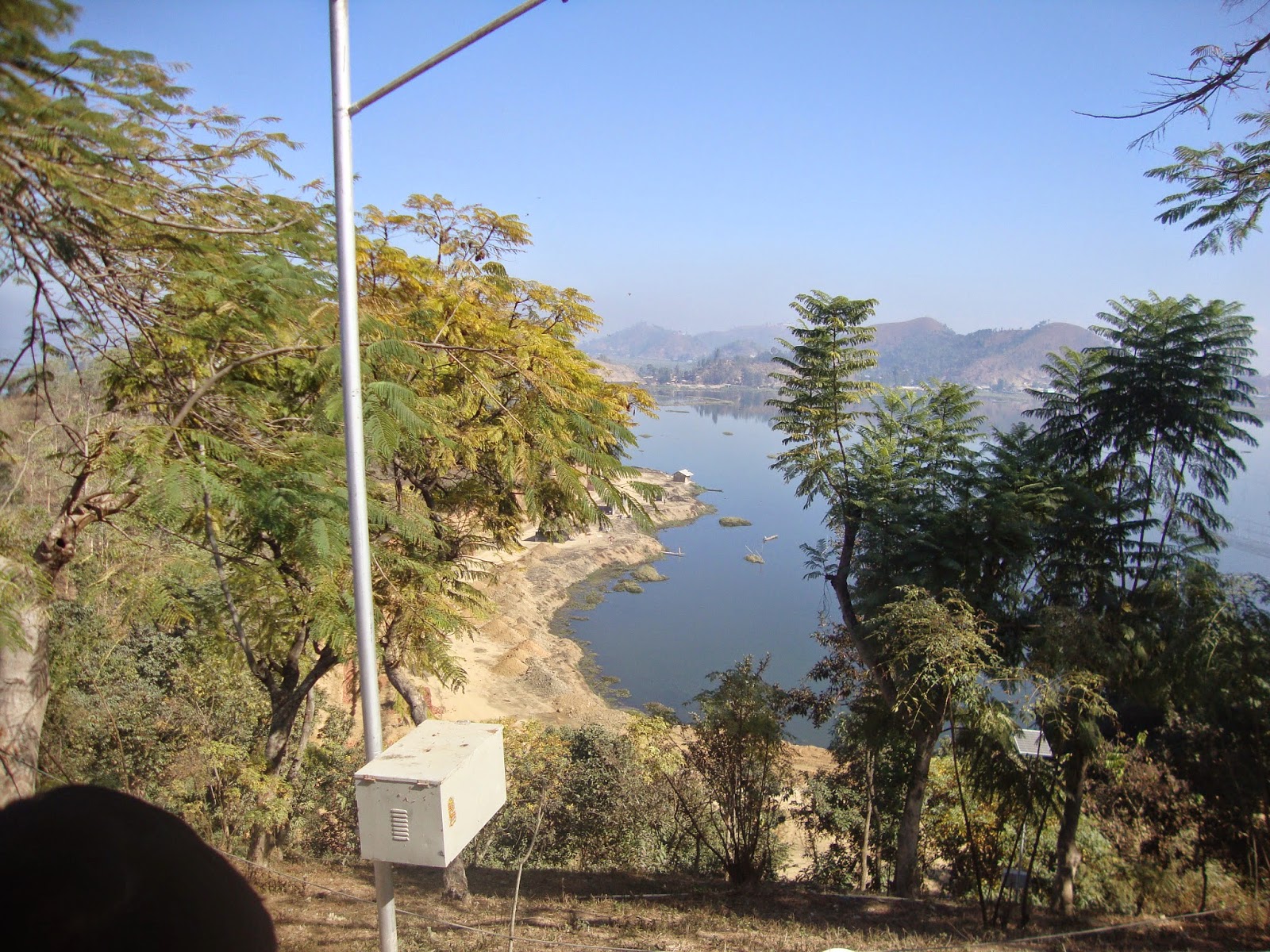
(Loktak Lake)
Loktak Lake is the largest freshwater lake in North East India. It’s situated near Moirang, forty five kms away from Imphal. It’s also known as ‘Floating Paradise’. While climbing the hill at Loktak, a person standing in a corner, pointed to Nelo Singh the detached mudguard of the Bolero he was driving. Parking the vehicle on the hill top Nelo noticed it and wanted to get it fixed while we would have a look at the Lake. After nearly half an hour we got back to the place where we had left Nelo and found the person who had pointed out the detached mudguard. He was in tracksuit and holding a few tourist books on north east. He introduced himself as Vinod Patel from London.
He said, “I am originally from Modiland i.e Gurarat. My father was a British civil servant in Kenya. I was born in Kenya. When Kenya got independence from the British we were treated as foreigners, and asked to leave the country. We had to leave, and leave everything in Kenya, our property and all. We came to UK as pauper. In UK we are also not treated as equals to the British citizens. I am a person who cannot have emotional claim of a land as his own. Neither UK nor India, and we are driven out from the country where I was born.”
Vinod Patel, besides English, speaks manageable Hindi and fluent Gujarati. He says, though they have been staying in foreign land before his birth (He is now at 63), their family language has been always Gujarati. He has visited almost whole of India. This year he is on north east tour. Then, he asked whether we were going to Kaibul Lamjao National Park to see sangai. Of course we did not have the plan. He said, “How could you return from Loktak without visiting the Park, only ten kms away and miss the chance of seeing sangai? You may not have another chance to come to Manipur.” Sangai is called the dancing deer. “It’s only seen in Manipur, nowhere else. It’s also an endangered species. If you miss the opportunity this time, you may not have a chance second time, even in your life. If you get a chance to come again from Odisha, the deer might have become extinct by then.” He added. We were influenced. We decided to go. Then, he requested to take him in our vehicle. We agreed.
He did most of the talking and we listened. In fact, he became our leader and in a way, hijacked us. We reached the park, bought tickets for him and also for the vehicle and reached the spot. We did not find a deer; only a long stretch of tall grass where they told the deer lived. In a board, we saw the picture of the deer only and read, in the last count in 2013, the number of deer survived was only 204. It was 12 noon when we reached. This was not the time a deer could be noticed. We were told by a forest official posted there that we could see in the morning only and that was possible if we would have stayed the previous night there. We had to be satisfied with seeing the habitat of the deer.
We returned and dropped Mr Patel on our way back at Loktak. We spent extra Rs 750/ the driver charged for our journey to the National Park and for the tickets. The next day we met him in the dining room during breakfast. We asked when he returned the previous day. He replied at 10 in the night and said, he happened to meet a doctor who took him to a few beautiful places. We realized how he could he have enticed the doctor. He is a true tourist who loves to see the places and the things. He does not carry a camera, or a mobile phone. He says, “Everything is captured in my mind.”


                                                         (Vinod Patel in the middle)

*****
In the Sahitya Akademy function, a lunch was arranged by the functionaries of Manipur Sahitya Akademy. The lunch contained dry fish curry. Of course, I love dry fish, and we eat at home, but the preparation of the curry was not to my liking. We could not relish it. In Odisha, dry fish is not served in any feast. I asked about dry fish to our driver Nelo Singh. He said, people in Manipur are fond of dry fish. Dry fish of different quality is sold. The price varies from Rs 300/ per kg to Rs 1000/. At the viewpoint of Kaibul Lamjao National Park we found some labourers preparing their mid day meal. We found they had boiled rice and dry fish chutney for their lunch.  
*****
We were told to visit at least Kangla Fort and Ima market in Imphal. Kangla, situated in the heart of Imphal city, was the capital of Manipur. Kangla was the royal palace since the reign of Pakhamba who ascended the throne in 33 AD. It was a seat of political power as well as a holy place for religious worship and ceremonies. Kangla has grown into a fortress through centuries. There is a moat surrounding the fortress. Inside the fort situated Sri Govindjee Temple and Ibudhou Pakhambagi Sanglen. Sri Govindjee Temple was built in 1846 AD. It was damaged in an earthquake in 1868 AD. Later, it is reconstructed. The priest at Ibudhou Pakhambagi Sanglen said, this has been the deity worshipeed by the people before Hinduism entered into Manipur. The deities look like Radha and Krisna.


                                             (Ibudhou Pakhambagi Sanglen)

Ima Keithal or mother market is entirely run by women. ‘Ima’ in Manipuri means mother and ‘keithal’ means market, it’s known as Ima market. There are around four thousand women stalls in this market. It is said, this is the only market in the world to be entirely managed by women. One cannot find a single man selling goods here. Even there are a few male buyers. They sell clothes and handicraft, shawls, bedspreads, fish, vegetables, utensils, etc and also dry fish. We noticed at one place a woman selling cockroaches along with dry fish. Ima market is more than hundred years old and it shows the dominance of women in Manipuri society.
*****
We three (Gour, Prdeep and myself) are staying in Bhubaneswar, but we hardly meet each other. We are busy in our own work. First time, perhaps after fifteen years, we had the chance of having all the time for ourselves after we reached Bhubaneswar airport on 21st December till 26th December. We could freely talk completely free of any worldly worry. Pradeep met Jyotirekha Hazarika, a poet from Assam after ten years. He had met her ten years back when she had come to Odisha. Jyotirekha presented him with a red scarf which he fondly wore on his shoulder. On our way back we had to stay a night at Kolkata, and enjoyed wandering on the street with jhalmudhi and sandesh.


                                                          *****


Sunday, November 9, 2014

Ranipur-Jharial


Kalahandi and Balangir districts of Odisha are often in news for wrong reasons. In 1985, poverty forced Fans Punji to sell her sister in law Banita for Rs 40 only, that exposed the stark poverty of the region and attracted the attention of national, even international media. The Prime Minister Rajeev Gandhi along with his wife had visited the place and met Fans. On 2 October, this year, on the birth day of Mahatma Gandhi, when the world observed the day as day of non violence, around twenty thousand animals and birds were slaughtered on the occasion of Chhatar yatra of Goddess Manikeswari at Bhawaniptna. The road of Bhawanipatna was flooded with blood. A few days back, in the last week of September, one Bankee Behera of a village near Bangomunda block killed an innocent seven year old boy to propitiate Goddess for his good health. But Kalahandi and Balangir districts have a rich heritage and a glorious past that goes unnoticed in the midst of poverty, superstition and black magic. Ranipur-Jharial where one finds ancient monuments and reminiscence of Saivism, Vaishnvism, Tantra and Buddhism, is testimony to the richness of the past, which speaks of affluence of the region in earlier times.
Ranipur-Jharial is in Bangomunda block, around 110 kms from Balangir. On the day of Vijaya Dasami, 4 October, 2014, when we reached Ranipur in the afternoon, Jagmohan Tripathy, the priest of Someswar temple was inside the temple worshipping for a few devotees. He was informed of our visit earlier by a common friend. On seeing us, he came out to act as our guide handing over his charge to his young assistant.
Someswar temple is situated beside Someswar sagar. The place is known as Somatirtha, which finds mention in the puranas of 3rd- 4th century AD. It is said one Saiva Acharya, Gagan Shiva had built the temple, whose name has been mentioned in an inscription found on the lintel of the temple. The inscription also mentions the place as Somatirtha. Tripathy showed us an image engraved on the inner side of the wall to be of a Shaiva saint that might be of Gagan Shiva.
On a rock surface of around two square kms there are 51 temples of varied shape and size standing in dilapidated condition. In 1874-75, archeologist J D Beglar had visited the place and counted 57 temples, and noted there might be around 120 temples in earlier times. The temples were built during Somavansi rule in 8th century AD. Historian K N Mohapatra assigns the period of the structures to 650 - 950 AD.


Chausasthi (64) yogini of Ranipur-Jharial is one of the four remaining of the famous temples of the kind. The others are at Hirapur near Bhubaneswar, Khajuraho and at Bheraghat near Jabalpur. It is a circular roofless temple and joginis are installed in the niches of the inner side of the wall. In the middle of the temple, stands an image of six handed Shiva. The jogini temple smacks of occult practices. Historians are of the view that the jogini temples are built when Brhminical tantricism gained popularity during 6th-7th century AD.
Hundred metres away from the jogini temple stands Indralath brick temple. The sikhara of the temple is 60 ft high standing on a high sand stone platform. Historians say that it was a Vaishnava temple, but later it was converted to a Shaiva temple. This is the tallest surviving brick temple in Odisha.


Near Someswar temple one finds foot print emblems. The priest Tripathy and the locals believe those foot prints were of Sita Devi and Ramachandra of Ramayan who had visited the place during their fourteen year forest exile. But historians attribute the foot prints to its association of early Buddhist worship. The existence of Buddhism is also corroborated by discovery of a Buddha statue in the village Ranipur.


Belief defies law and logic. Despite law against cruelty and   killing of animals, slaughter of animals continues in Manikeswari of Bhawaniptna, Pateneswari of Patnagarh or in the Sulia yatra. In Sulia yatra of Khairagad village of Tusura police station of Balangir district, people defied the order of the High Court of Odisha and imposition of 144 of Cr P C by administration and killed thousands of buffaloes, goats, sheep and hens. While chatting with Sanyasi Bhoi, a resident of the village Ranipur, he said, in the early seventies of the last century, A N Tiwari, bureaucrat and a lover of culture had visited the place. He was appalled to find animals were sacrificed before the statue of Buddha, the epitome of non-violence.  Sanyasi said, Buddha was worshipped under a silk-cotton tree in the Ranipur village as Bhima Debta and animals were killed before it to propitiate the Debta (God) for good rainfall. Tiwari stopped the practice of sacrificing animals before the Buddha statue and brought the statue from the silk-cotton tree and kept it in the Indralath temple. The statue is kept in one corner of the Indralath temple.


 Mrutyunjaya Pardhi, the retired Head Master of the school of the nearby village, Sindhekela said, if a child or a woman gets fever, people of the locality believe, evil spirit has entered in the body of the child or the woman. The exorcist is called, and he performs puja in the precinct of the chausathi yogini temple late in the night. Rooster is sacrificed to satiate the Goddess and to ward off the spirit from the body. 
Poverty and lack of education make the people superstitious and believe in black magic. The site is neglected by the tourism department. There is a guest house which remains always closed. There is no restaurant, nor any publicity to attract tourists and visitors. Although Someswar sagar(lake) has been developed and boating arrangements have been made, care is not taken for its cleanliness. We found plastic cups and plates were heaped in a corner of the lake, that gives a bad look. Government should take steps both to eradicate poverty and educate the local people, and at the same time preserve the rich heritage. The visitors, tourists and picnickers need to be conscious to keep the place clean.
                                                    xxxxx
( This article was published in the Pioneer on 5 November 2014 under the caption " Ranipur-Jharial speaks of Balangir's cultural affluence" )

Friday, February 28, 2014

Buddhist Diamond Triangle


                                       ( The Gate at Ratnagiri)

It was the second day of the three day Raja festival. The festival is observed by agrarian people of Odisha at the onset of monsoon. They refrain from work and give rest to Mother Earth. Children clad in new dress eat cakes specially prepared for the occasion, play and do merrymaking. As decided earlier, we started our journey to visit Buddhist sites of Ratnagiri, Udaygiri and Lalitgiri, called the Buddhist Diamond Triangle.

Monsoon had set in and there was intermittent rain. When we took a diversion from Daitary-Paradeep national highway at Krushnadaspur towards Ratnagiri, the rain had stopped. On the one side of the road from Krushnadashpur to Ratnagiri there were green sugarcane fields and on the other side, there were hills and here and there, date and palm trees. Boys and girls were playing in swings hung from the branches of mango or banyan trees near the road side villages. Used to city life, we felt like entering into a different world.

We reached Ratnagiri at around 11 AM.

Bishnu Charan Mohanty, a social worker and an active member of Puspagiri Parisad, an organisation dedicated for development of the Buddhist sites was waiting for us.

Hiuen Tsang, the Chinese traveller visited India to study Mahayan Buddhism. Since he was not permitted to travel to India, he secretly came and reached Gandhara in 630 AD. He passed through Odisha and visited Buddhist sites during 638-641AD. He had mentioned in his accounts a famous monastery pu-sie-po-ki-li or Puspagiri which has not yet been identified satisfactorily by the historians. He has also mentioned existence of a stupa north to Puspagiri, which is identified as Ratnagiri. Hiuensa Tsang’s accounts testify that Odisha’s Buddhists were of Mahayan sect.

Odisha’s relation with Buddhism was from the early times, from days of Buddha himself. Two merchants of Utkal, Tapassu and Bhallika while passing through the middle country met Buddha and offered him rice cakes and honey. They became his disciples. Ashoka, emperor of Magadha had won Kalinga war fought in 261 BC, but after his victory he shunned violence forever, embraced Buddhism and propagated message of peace. The elephant figure, hewn in those times at Dhauli was the symbol of the birth of Buddha and was, perhaps, intended to remind the people of Kalinga of the Buddha and his teachings. Taranath, the historian speaks of the Ratnagiri monastery which was built on the top of a hill, where three copies each of Mahayan and Hinayan Buddhism and other scriptures were kept.

Bishnu Babu acted as our guide. The Buddhist relics of Ratnagiri were first brought to notice of the scholars in 1905 by Manmohan Chakravarti, then Sub Divisional Officer of Jajpur district. Excavation was conducted under the direction of Debala Mitra during the year 1958-61. Excavations revealed a massive stupa, two monasteries, shrines, and numerous votive stupas, a large number of terracotta and stone sculptures, and Buddhist antiquities including bronze, copper and brass objects. The centre of attraction here is a massive seated Buddha in bhumisparsa-mudra flanked by the standing figures of Padmapani and Vajrapani holding chamaras on each side, in the central sanctum. The finest relic of Buddhist art is the gate of Ratnagiri monastery.
                                              ( Buddha in Bhumisparsa mudra at Ratnagiri)

         An aesthetically planned three terraced building houses an archaeological museum which was completed in 1990, and started functioning in August 15, 1998.  The museum consists of four galleries displayed with various antiquities mainly related to tantric Buddhism including small votive stupas, sculptures of different medium and dimensions in stone, bronze, ivory, copper and stone inscriptions and terracotta seals.

Udayagiri, also known as “Sunrise Hill,” is only nine km away from Ratnagiri. This Buddhist site is enriched with a brick stupa, two brick monasteries, a stepped stone deep well which never goes dry even in hot summer. The deep well was constructed during those days when use of rope for lifting buckets of water was not known.

The stupa at Udayagiri has four seated stone statues of Buddha, enshrined and facing each direction. There is an extensive monastic complex with 13 cells and a towering statue of Budhhha seated in bhumisparsa mudra. Besides, sculptures of Buddha and other Buddhist divinities like Tara, Majusri, Hariti, Chunda, Vasudhara,etc have been discovered in large numbers at the site.
( Bamphi, stepped stone deep well at Udayagiri. The well never dries even in hot summer)

Lalitagiri is about 10 km far from Udayagiri. Excavations have unearthed an apsidal chaitya hall or chaityagriha, four monasteries and stone sculptures of Buddha and Buddhist divinities. Worth mentioning discovery in Lalitgiri were three relic caskets, two containing small pieces of charred bones inside the stupa. Buddhist literature says that after the death of Buddha, his corporal remains were distributed among his disciples to be placed within the stupas. The remains preserved in the caskets are believed to have belonged to the Buddha himself.

At one time Buddhism was the dominant religion in entire Odisha. Later, Buddhism started disappearing as it lost royal patronage in and around 700 AD. Its survival also became difficult. With the revival of orthodox Brahminical religion, Buddhists were harassed and even murdered. In course of time Buddhism was also assimilated in Hinduism and lost its identity. Buddha was deified and accepted as one of the avatar or incarnation of Bishnu in Hinduism. Buddhism disappeared from the land of its birth.

Ratnagiri and Udayagiri sites have Mahakala temples which were later developments with the revival of Brahminical orthodoxy. It was already two in the afternoon when we reached Udayagiri. Blood stains in front of Mahakala temple at Udayagiri astounded us. There were intermittent rains from the early morning. The downpour had not washed away completely the blood stains. Dr Bhagyadhar Sahoo, retired head master and a scholar of the locality told that goats had been sacrificed before Mahakala on the occasion of rajasankranti. Later, we learnt from newspapers that more than fifty goats had been sacrificed the next day before the Mahakala at Udayagiri.
( Mahakala Temple at Udayagiri where goats are sacrificed)
Buddhism was born in reaction against violence in Brahminical religion, especially against animal sacrifice. Buddhism preaches peace and non-violence. Animal sacrifice is a punishable offence under the law. Still, violence and sacrifice do not stop. Insides the sites of Buddhism which was founded on the principles of non-violence, people do not have any scruple to sacrifice animals and cause bloodshed.

Hiuen Tsang in his accounts describes the people of Odradesa that includes present district of Jajpur  were of violent ways, and were different from the mid country. One thousand and five hundred years after the visit of Hiuen Tsang and despite progress of civilisation, sacrifice in the Buddhist precincts testifies to the fact that the violence in the man has not died out.
( With inputs and photographs from Sefali Suman)

xxxxx

Saturday, February 8, 2014

All Those Days


The persons born in rural India in the early nineteen hundred fifties had a chance to see a TV in 1982. By that time he had completed his education and had been into a job, most likely a government job, and already married and with children. He might have not a telephone connection to his residence unless he was a high ranking government officer or a wealthy businessman. Hardly had he gone out of the country. If someone got a chance to go abroad, it was news under the caption “An Odia on Foreign Tour”. Income Tax Department had also a rule that a person who had visited a foreign country in the year or had a telephone connection, above all things, was required to file income tax return.
 
Things have changed in the last one and half decades and we may call the change ‘revolutionary’. Globalization has brought changes in the economy and society, and also in the attitude of the man. Internets, mobile phone, social networks like the facebook have shrunk the world. A person in the nine hundred eighties could not have dreamt that he could talk to his wife at home while he was traveling in a train by use of a mobile phone. Sitting in her drawing room a half educated house wife of the village could watch the culture of the African society as well as that of the developed European countries. The changes have impacted the life of the people. Economic changes and industrialization have broken down the joint family system and even affected the institution of marriage. Instead of staying together bound in a marriage till death people now started preferring to a live-in relation. The story Nila Mastrani (Nila, the teacher) was written in 1955-56. In the story, Nila, a Brahmin girl fell in love with Madan Sethy, a scheduled caste boy, and married him. After marriage she was not only socially ostracized in her own village, but also condemned in the region in nearby villages. She cannot attend the marriage of her loving brother whom she has brought up with love and care after the death of their parents. The story sahabas (Living together) is written in 2010. In the story, Subrat and Anupama, both highly educated and employed with fat salaries have decided to live together in an apartment without marriage. No one bothers, not even the man living next door.  The people have appreciated the story and accepted the fact.
The novel seisabau dina (All Those Days) captures the change. Sanatan, a teacher represents the fifties of the nineteenth century and Niranjan represents the present time. The story of Sanatan is told in form of short and inter-connected stories. The novel was first published in the puja special issue of Arpita, 2012 and now the book is published by Sudha Prakasan, Cuttack